Communicating sustainability
€ 490
including VATHow to design a pathway that starts from the company’s sustainability strategy and is translated into appropriate messages and tools to best convey the organisation’s sustainable soul.
Communicating sustainability

€ 490
Buy the courseCommunicating sustainability
The course aims to share the fundamental principles needed to set up a sustainability communication plan.
It is important to keep in mind that communicating sustainability requires specific knowledge and actions that differ from those used in traditional communication.
It is therefore necessary to design a path that starts from the company's sustainability strategy and is translated into appropriate messages and tools to best convey the organization's sustainable soul.
The course is aimed at company communication managers, CSR and sustainability officers, and recent graduates who wish to explore topics related to sustainability communication with the goal of working on these issues within a company.
The course is divided into 5 video-recorded modules available for streaming on the Circularity Platform.
The entire course or individual modules can be purchased by credit card or bank transfer and followed via streaming on our platform.
Once purchased, they are valid for 100 days.
At the end of each module, you can take a quiz to test your level of learning.
At the end of the course, a personal certificate of participation will be issued.
The course price is to be considered VAT included.
Purchase by credit card or bank transfer
Assessment quiz available at the end of the course
Watch the first video of Module 1 as a free preview
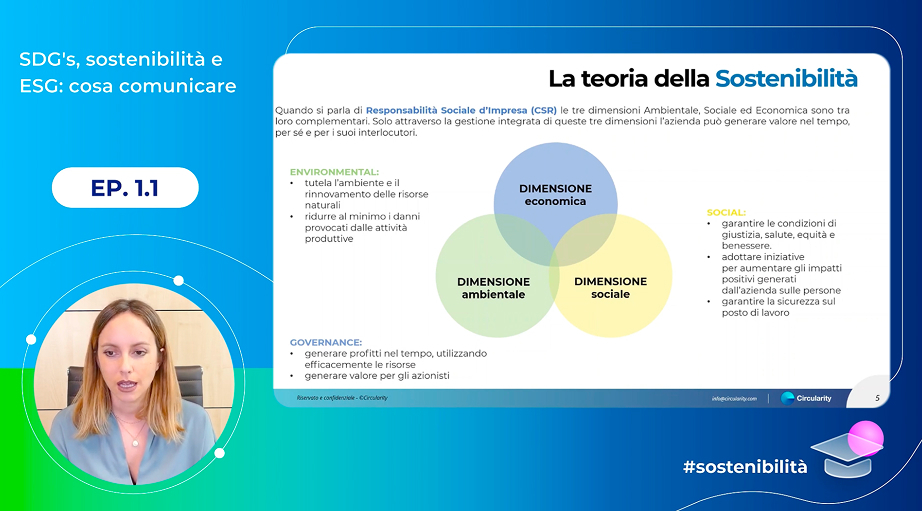
“SDGs, sustainability and ESG: what to communicate"
Course contents:
“Communicating sustainability”
1.1 SDGs, sustainability and ESG: what to communicate
When we talk about Corporate Social Responsibility (CSR), the three Environmental, Social and Economic dimensions are complementary to each other. How to best communicate the integrated management of these three dimensions within a company, generating value over time for itself and its stakeholders.
1.2 Avoiding misleading communication: greenwashing and green labels
Overview of benchmark companies committed to communicating their sustainability: best practices and worst cases.
1.3 Setting up a communication plan: benchmark of excellent cases.
How to design a path that starts from the company's sustainability strategy and is translated into appropriate messages and tools to best convey the organization's sustainable soul.
2.1 Communicating sustainability with Content Marketing

Website, blog, newsletter. By focusing on creating engaging content around environmental and sustainable topics, GCM aims to educate the public, building a bridge between users and the multitude of scientific information that is often not accessible to all.
2.2 Effectively using social media to communicate sustainability
The main communication and social media tools integrated into corporate communication strategy: social editorial plan, effective content, reputation and community management.
2.3 Online storytelling about sustainability
Different languages depending on the channel: how to create and promote webinars, podcasts and content to effectively share your commitment by following the benchmark of the most successful projects.
3.1 The sustainability report
One of the main tools for communicating corporate sustainability. We explore current regulations, the most effective report structure, graphics and highlights.
3.2 TV, press, events, media relations and partnerships
Traditional communication refers to the conventional methods of communication used before the advent of modern digital technologies and social media: which ones are still effective and how to make the most of them.
3.3 Unconventional marketing
Activation and amplification with out-of-the-box projects: best cases of ambient and guerrilla marketing to share your sustainability projects.
4.1 Tools for communicating sustainability within the company
Analysis of internal sustainability communication and the tools used to build engagement and achievable goals through intranet, newsletters and gadgets.
4.2 Engagement of the internal audience, the employee as Ambassador
Employees as the brand's first ambassadors: town halls, roadshows, team building, academies and internal influencers.
4.3 Sustainability within the organization
To engage employees on ESG topics, they need to feel them as their own on a daily basis: Welfare, Wellbeing, D&I, work life balance, code of ethics and workspaces.
5.1 Emerging technologies for communicating sustainability
Augmented reality, immersive platforms, artificial intelligence: new tools for communication.
5.2 Creating interaction and engagement around ESG topics
Gamification, projects in collaboration with NGOs, non-profits, schools and local communities to engage all stakeholders.
5.3 Rewarding and being rewarded
The importance of receiving recognition for sustainability, benchmark of awards, evaluation criteria and rankings.
Our teachers