
Sustainability in Practice – Advanced
€ 736
VAT includedThe course “Sustainability in Practice – Advanced” explains all the practical tools that a company or an ESG expert can use to demonstrate a genuine commitment to incorporating sustainability into their development strategy.
Sustainability in Practice – Advanced

€ 736
Get the courseSustainability in Practice – Advanced

The course covers in detail the most central topics to know when talking about sustainability, such as sustainable supply chain management, ESG performance reporting, measurement and reference standards, regulatory updates, sustainability reports and the NFS, and product or process certifications.
The course is structured in 9 modules, video-recorded and available in streaming on the Circularity Platform.
The entire course or individual modules can be purchased by credit card or bank transfer and followed in streaming on our platform.
Once purchased, they remain valid for 100 days.
At the end of each module, you can take a quiz to test your level of learning.
At the end of the course, a personalized certificate of attendance will be issued.
The price of the course is to be considered VAT included.
Purchase by credit card or bank transfer
Assessment quiz available at the end of the course
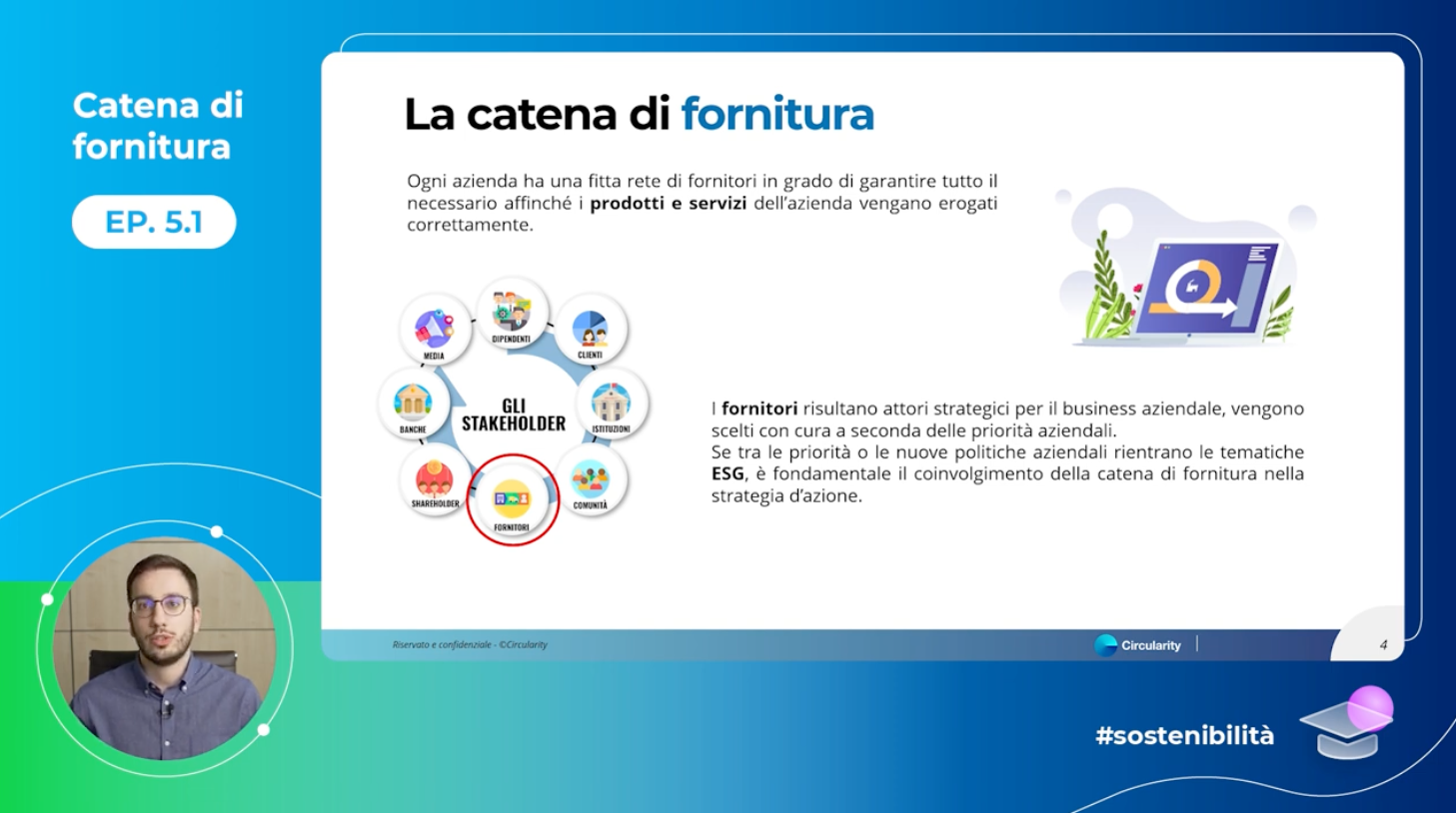
Watch a free preview of the first video of Module 5
“ESG risks arising from the supply chain”
The course contents:
“Sustainability in Practice – Advanced”
Sustainable Development has become a priority in all growth strategies of companies and governments. Knowing the tools, regulations, and European and national political strategies are the first fundamental steps to introduce sustainability in a company.
1.1 The current global scenario
Our civilization is starting to come to terms with the excessive impact we have caused on the planet, the economy, and society. We must review our growth models and start basing them on sustainable development.
1.2 Origins and history of sustainable development
Since the industrial revolution, the human-nature relationship has caused increasing damage and environmental disasters, bringing to light the need for a change of course. From the 1960s, the journey of defining sustainable development began, leading up to the publication of the 2030 Agenda.
1.3 The signs of an unsustainable future
Current society and its economic model are bringing our planet to the brink of collapse, preventing sustainable development for future generations. There are a number of interconnected factors that require continuous monitoring and improvement to understand that we have reached the time for necessary change.
1.4 The theory of Sustainability: triple aspect (social, environmental, economic)
Sustainable development has as its main objective tackling the major problems of our society, from the environmental issues of our planet, to the economic development of less developed countries, all the way to the social aspects that connect people.
The UN 2030 Agenda for Sustainable Development and its 17 Goals (SDGs) are a fundamental tool for measuring, monitoring, and implementing sustainability within corporate strategies.
2.1 The structure of the 2030 Agenda
The UN 2030 Agenda is a powerful tool to avoid “forgetting” any of the various sustainability goals that must be achieved by companies, governments, and individual citizens by 2030. Its features of Universality and Interdependence make it possible to respect the different social, environmental, and economic objectives of our society.
2.2 The ENVIRONMENT – PLANET goals
This episode explores the main goals related to how our human activities must respect our planet and all the biodiversity that distinguishes it. It clarifies the elements to consider in order to reduce our impact as much as possible and not deprive future generations of the same opportunities for development that we have.
2.3 The SOCIAL – PEOPLE-PEACE-PARTNERSHIP goals
An in-depth look at the goals related to the social aspect of sustainability, how they can be interpreted in companies, and what contribution can be made by for-profit organizations and the third sector.
2.4 The GOVERNANCE – PROSPERITY goals
Sustainable development also supports economic and equitable prosperity for all individuals and public and private entities. Industrial activities, cities, and work in general must embed sustainability in their foundations to enable an increase in economic well-being.
The political context is constantly evolving and sustainability is becoming an important driver for the development strategies of Europe and its Member States. Knowing the rules, regulations, and concrete tools that govern sustainability allows you to anticipate decisions and be ready for the change underway.
3.1 Europe and Sustainability
European and national overview of sustainability policies (European Green Deal, the sustainability roadmap, EU strategies, etc.).
3.2 Ecological Transition
The Ecological Transition is the shift or transformation from an intensive production system that is unsustainable in terms of resource use, to a model that instead has its strength in environmental, social, and economic sustainability.
3.3 National/Regional Plan for Sustainable Development
The National Strategy for Sustainable Development (SNSvS), adopted with CIPE Resolution 108 of 22 December 2017, transposed at the national level the principles of the 2030 Agenda and its Sustainable Development Goals (SDGs) and represents the reference programmatic framework for the development, monitoring, and integrated evaluation of related policies.
3.4 NRRP
The National Recovery and Resilience Plan (NRRP) defines Italy's program of reforms and investments for the following 4 years, in order to use the Recovery Fund. The plan must be aligned with the specific recommendations of each country, and must strengthen growth potential by paying particular attention to the green and digital transition.
ESG (Environmental – Social – Governance) issues are essential for competitiveness in the market. In addition to implementing them, it is important to know how to communicate them correctly without falling into greenwashing.
4.1 The introduction of ESG principles
A company, the productive world, or economic systems in general, can use the tool of disinvestment or investment as an effective weapon to mobilize sustainable change. The ESG principles (Economy – Social – Governance) are the tool for introducing Sustainable Development into the choices of the productive world.
4.2 Communication and Greenwashing
It is essential to gain CREDIBILITY by integrating sustainability into business. Communication thus takes on a crucial role in building trust and conveying the solidity of the chosen business.
4.3 A sustainable supply chain
To qualify a sustainable supply chain and understand the sustainability characteristics of suppliers, several key tools related to sustainability can be used. A range of information can be obtained from the supplier to verify their approach to sustainability, using certifications, sustainability reports, and sustainability assessments.
4.4 Sector examples and case studies
A series of examples of how some companies have introduced the principles of Sustainable Development into their corporate development strategies.
Suppliers are strategic players for the company's business, chosen carefully according to corporate priorities. If ESG topics are among the priorities or new corporate policies, involving the supply chain in the action strategy is essential.
5.1 ESG risks arising from the supply chain
Since suppliers are strategic stakeholders for achieving corporate objectives, it is essential to assess the associated risks, be aware of them, and prepare for any critical issues through risk analysis (e.g. ERM).
5.2 Developing a supply chain management strategy
Once the need to identify risks due to the supply chain has been established, a supplier evaluation, monitoring, and subsequent management strategy must be defined. The objective is to identify the impacts and risks that can be generated by the organization and that can affect it. An ad hoc strategy will then be implemented by the company carrying it out, based on its own corporate objectives.
5.3 Monitoring and evaluation system for supply chain performance
When a company makes the strategic choice to carry out an ESG evaluation, partial or complete, of the supply chain, it must define the methods for performing it. It can choose a Partial approach (evaluation of a single criterion chosen by the company) or a Complete approach (overall evaluation of ESG topics).
5.4 Communication and reporting
Internal communication within a company serves to spread corporate values, achievements, and future objectives. Proper communication ensures greater efficiency, reduces the repetitiveness of communications, and leads to greater employee engagement with corporate values and objectives.
All actions related to ESG topics that a company undertakes can (and must) be reported and presented in specific reporting models to enable a uniform comparison between different organizations.
6.1 The Sustainability Assessment
The Sustainability Assessment is a tool for evaluating corporate Sustainability as a snapshot of current performance against each Sustainable Development Goal (SDG). With this tool, you obtain your own level of understanding and real integration of sustainability within your company, and an improvement plan is suggested to achieve the set objectives.
6.2 Reporting standards: international guidelines (GRI, SASB, IIRC)
Environmental, social, and governance (ESG) reporting has received considerable attention in recent years, which in turn has contributed to a “boom” in sustainability reporting standards, targets, and regulations. The main reporting tools are presented.
6.3 CSR and CSRD: are they the same thing?
CSR is a form of voluntary responsibility that companies intend to assume towards their main social interlocutors (stakeholders). The CSRD (Corporate Sustainability Reporting Directive), on the other hand, aims to make non-financial disclosures by European companies clearer, more complete, and more comparable to each other, like financial accounting and reporting.
6.4 Preparation and formalization of a sustainable strategy
A structured and effective sustainability journey must start from a medium-term reflection aimed at identifying the priority areas of intervention for the company, starting from a gap analysis and the enhancement of ongoing initiatives. The journey must therefore combine the immediate need to position oneself on the topic with the opportunity to adopt a medium-term oriented approach.
The sustainability report is a corporate reporting tool that evaluates the economic, social, and environmental impact of an organization. It provides a detailed overview of corporate performance in terms of sustainability, including aspects such as resource use, impact on climate change, management of relationships with stakeholders, and the integration of ethical principles. The sustainability report helps companies monitor and communicate transparently the progress made towards responsible and sustainable management.
7.1 Sustainability reporting: NFS, Sustainability Report, Gender Report, Environmental Reports
The EU has introduced a range of initiatives aimed at promoting sustainability reporting. For example, in 2014 the Non-Financial Reporting Directive (NFRD) was introduced, which requires large companies to report information relating to environmental, social, and governance issues. In 2021, the European Commission proposed to update this directive in order to ensure greater consistency in reporting and to extend it to a larger number of organizations.
7.2 Materiality analysis
Materiality analysis aims to assess the significance of a set of areas concerning sustainability in its three ESG dimensions, economic, environmental, and social, according to the guidelines of the Global Reporting Initiative (GRI) and the International Integrated Reporting Council (IIRC).
7.3 The structure of a sustainability report
The sustainability report reflects the three pillars: economic, social, and environmental. In these pillars, the company's performance in the respective areas is represented, including financial data, social impact, resource management, and actions for environmental protection.
7.4 The data to be reported
The GRI Standards represent the global reference point for sustainability reporting. Reporting developed in accordance with the Standards provides information regarding the positive or negative contribution to the sustainable development of an organization and allows for reporting one's own impacts according to ESG criteria (Environmental, Social, and Governance). The GRI Standards, modular and interrelated, are primarily designed to be used as a set, to prepare a Sustainability Report starting from the material topics that have emerged, the related impact, and how they are managed.
To demonstrate the concrete implementation of sustainability actions, companies can and must undertake certification paths to be in compliance with possible regulations and, above all, to stand out in the market.
8.1 The world of certifications
Certifications are a fundamental tool to verify and validate certain characteristics of a product or process. Understanding their structure and how they are created and verified allows you to choose the best certification for each specific occasion.
8.2 Process and product certifications
Product or service certification is a form of “direct assurance” by which the conformity of a product or service to applicable requirements is verified, while process certification ensures an organization's ability to structure its processes in such a way as to recognize and meet stakeholder needs, committing to continuous improvement.
8.3 Supply chain measurement and certification
The evaluation in the context of selecting “sustainable” suppliers can focus on different levels: in the evaluation of purchases, the focus will be on the products supplied by the supplier company. While in the evaluation of an organization, the focus will be broader and more systemic, taking into consideration the entire organization and its ability to structure processes and procedures attentive to sustainability aspects.
8.4 Examples of “sustainable certifications” for industrial sectors
Each industrial sector has its own specific certifications. The main certifications for the textile, food, and construction sectors are explored in depth.
The job market is increasingly looking for professionals prepared on sustainability issues. Corporate forms such as the benefit corporation or the B-Corp certification can also demonstrate concrete commitment and interest in sustainable development.
9.1 The sustainability market and the advantages for a company
Sustainability has become a priority for many governments, organizations, companies, and individuals, as the importance of protecting the environment, improving people's quality of life, and ensuring a sustainable future for all is recognized. This requires adopting business practices, public policies, and individual behaviors that are compatible with the limits of the planet's resources and capacities.
9.2 Green Jobs
A Green Job is any job or self-employed activity that really contributes to a more sustainable world. For people starting their professional career, the meaning and potential of green jobs is very high. According to numerous international studies, these new professional types are expected to reduce unemployment while at the same time preventing environmental degradation.
9.3 The Sustainability Manager according to UNI/PdR 109.1:2021
In order to encourage and increase greater awareness of professions focused on sustainability and to offer a useful tool at the national level for defining the characteristics of these professional figures, UNI, together with Intertek, Confassociazioni, and CSR Manager Network, published the Reference Practice UNI/PdR 109 “Non-regulated professional activities: professional profiles in the field of sustainability”.
9.4 B-Corp vs. benefit corporation
In recent years, growing awareness of social and environmental issues has led institutions and private organizations to rethink the way of doing business, recognizing the need to integrate such issues into the corporate business model. The Benefit Corporation and the B-Corp certification are two options to demonstrate a company's commitment to sustainability.
Our Teachers
Master’s degree in Environmental and Territorial Engineering, specialising in Environmental Remediation Technologies, from the Politecnico di Milano; qualified as a professional engineer, with a view to enhancing managerial and professional skills in current sustainability issues. Executive Master’s degree in Circular Economy Management from LUISS Business School. Specialises in sustainability, optimising waste management and treatment, and the principles and application of Green and Circular Economy in specific sector-based projects and within individual companies. Head of training on sustainability and the circular economy, with specific teaching roles on professional Master’s programmes at the Catholic University of Milan, 24Ore Business School and directly within companies through bespoke training programmes.
Having always been keenly interested in sustainability issues and eager to contribute actively to them, he began his professional career as a member of Circularity’s technical team, working as a Sustainability & Carbon Footprint Specialist.
He specialises in the analysis of environmental data within the context of sustainability reporting projects and in conducting carbon footprint studies. Finally, he delivers training courses on sustainability and the circular economy, both as part of professional Master’s programmes at the 24Ore Business School and the Catholic University, and directly to companies through dedicated training programmes.