

Skip to content
  • Circularity platform
  • Solutions
    Our services
    Sectors
    Segments
  • Courses
  • Information
  • Case History
ITA | ENG
Courses / ESG Manager
ESG Manager

ESG Manager

€ 440

VAT included

The ESG MANAGER Master’s programme will enable you to acquire technical skills and knowledge, so that you can become sustainability experts and establish yourselves as genuine sustainability managers within a company.

Level intensive
12h of video
3 Modules

ESG Manager

ESG Manager

Alberto Pizzocchero
Luca Russo
Leonardo Corbella
Fabiana Caiazzo
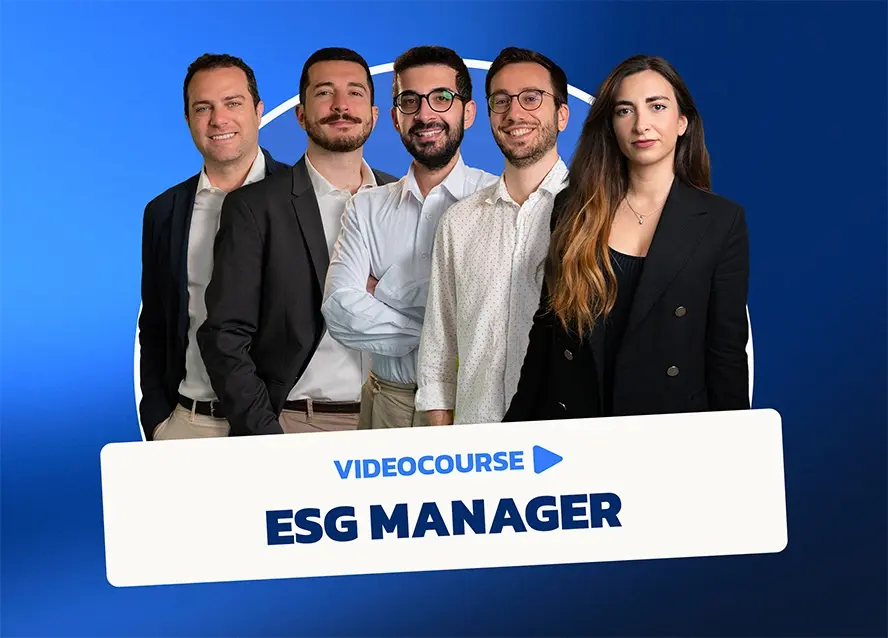
Teachers: Alberto Pizzocchero, Luca Russo, Leonardo Corbella, Fabiana Caiazzo

The training program is designed for Project Managers with prior experience in the circular economy and sustainability sector, as well as for recent graduates who want to acquire concrete knowledge and tools on sustainability.

The course is structured in 3 modules, video-recorded and available via streaming on the Circularity Platform.
The entire course or single modules can be purchased by credit card or bank transfer and followed via streaming on our platform.
Once purchased, they have a validity of 100 days.


At the end of each module, you can take a quiz to test your learning level.
At the end of the course, a personal certificate of attendance will be issued.


The course price is to be considered VAT included.

moduli-video
3 modules video-recorded and available via streaming
pagamenti

Purchase by credit card or bank transfer

durata-corso
Contents are available for 100 days
quiz-verifica

Assessment quiz available at the end of the course

certificato-frequenza
Personal certificate of attendance at the end of the course
thumb-corso-circularity-esg-manager

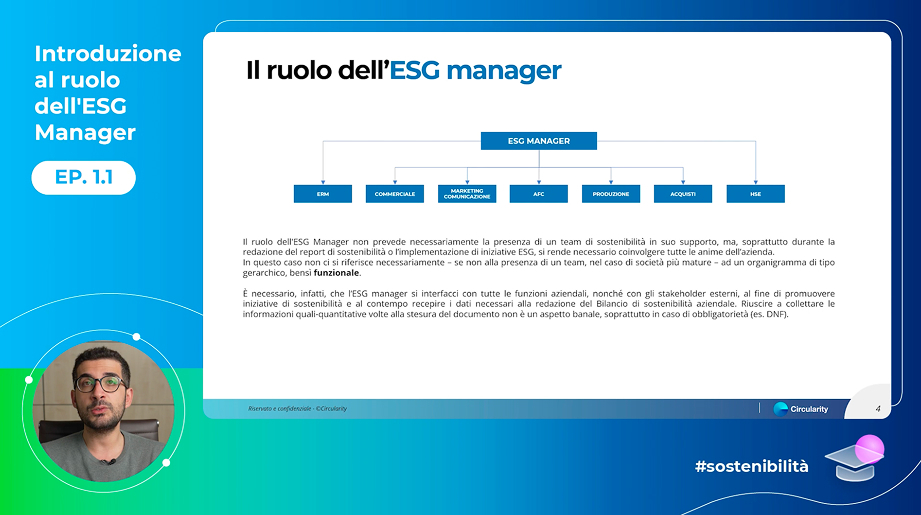
Watch the first video of Module 1 as a free preview

“The Role and Responsibilities of the ESG Manager in the Company”

Modules

The course contents:

“ESG Manager”

The ESG Manager has become a crucial professional figure with specific responsibilities and duties within a company. In this module, you will learn what their role is, which areas they need to handle, and which soft skills are most in demand.

1.1 The Role and Responsibilities of the ESG Manager in the Company
The ESG Manager is a professional figure increasingly in demand by companies across all industrial sectors. Not everyone can be a Sustainability Manager, nor can the position be delegated to other corporate functions. A specific identification of roles and responsibilities is needed to better define, implement, and monitor a sustainability strategy within the company.

1.2 Sustainability Strategies and Change Management
Sustainability has become a fundamental driver of development for any industrial sector and is integrated into sector strategies or individual activities. However, change management is needed, a shift in vision on the part of management in order to concretely integrate sustainability into the workplace.

1.3 The Sustainability Rating and Its Role in the Market
Financial rating agencies usually use a set of criteria to evaluate a company's sustainability, such as carbon emissions management, diversity and inclusion policies, or the presence of strong governance.​ This section addresses the topic of sustainability ratings in financial markets.

1.4 The Social Pillar: Leadership, Diversity and Inclusion
Social aspects within a company can be introduced by following ISO 26000, the international standard that has provided guidelines since 2010 on how every organization can improve its social responsibility and contribute to sustainable environmental, social, and economic development.​

The ESG Manager must have a certain set of skills to operate in the professional world with this title. The main topics and subjects that a sustainability professional needs to know are addressed here.

2.1 The SDGs (Sustainable Development Goals) UN Agenda 2030
The UN 2030 Agenda for Sustainable Development and its 17 Goals (SDGs) are a fundamental tool for measuring, monitoring, and implementing sustainability within corporate strategies.

2.2 EU Taxonomy
The Taxonomy allows all market players (companies, investors, financiers, and customers) to have a unified definition of sustainable activity that can be used in their decision-making processes.​ A unified classification helps to better direct capital flows toward sustainable choices.

2.3 Sustainability and Disclosure: Sustainability Report and Non-Financial Statement
The sustainability report is a corporate reporting tool that assesses the economic, social, and environmental impact of an organization. It provides a detailed overview of corporate performance in terms of sustainability, including aspects such as resource use, impact on climate change, stakeholder relationship management, and the integration of ethical principles. The sustainability report helps companies monitor and transparently communicate their progress toward responsible and sustainable management.

2.4 The GRI 2021 Standards
Environmental, social, and governance (ESG) reporting has received considerable attention in recent years, which in turn has contributed to a “boom” of standards, goals, and regulations on sustainability reporting. The main reporting tools are presented.

2.5 EU Directive, the CSRD (Corporate Sustainability Reporting Directive)
CSR is a form of voluntary responsibility that companies intend to assume toward their main social interlocutors (stakeholders).​ The CSRD (Corporate Sustainability Reporting Directive), on the other hand, aims to make non-financial disclosures by European companies clearer, more complete, and more comparable, in line with financial accounting and reporting.

The ESG Manager must know how to use certain tools in order to carry out their role in the company. The main tools and instruments useful to an ESG Manager in their daily work are addressed here.

3.1 SDG Compass, What It Is, What It's For, and How It Works
The SDG Compass is a tool that explains how the SDGs affect a company's activities, also offering instruments and insights on how to place sustainability at the core of their strategy, establishing mechanisms to measure and manage their contribution.

3.2 The Impact Report
A Benefit Corporation has in its statute a sincere will to act responsibly and over the long term in terms of sustainability, generating positive impact in the territory and on the stakeholders it deals with. To demonstrate the real impact these companies have, an impact report must be drawn up annually. ​


3.3 Circularity's Sustainability Assessment
The Sustainability Assessment is a tool for evaluating corporate Sustainability as a snapshot of current performance against each Sustainable Development Goal (SDG). With this tool, you obtain your level of understanding and real integration of sustainability within your company, and an improvement plan is suggested to achieve the set objectives.

3.4 SDGs Action Manager Tool and B Impact Assessment
The most widely used external standard for impact assessment of Benefit Corporations is the B Impact Assessment by B-Lab, an international non-profit organization founded in 2006 that promotes the social impact economy.

3.5 Supply Chain: Certifications and Guidelines
When a company makes the strategic choice to carry out an ESG assessment, partial or complete, of the supply chain, it must define how to perform it.​ It can choose a Partial approach (assessment of a single criterion chosen by the company) or a Complete one (overall assessment of ESG topics).

Teachers

Our teachers

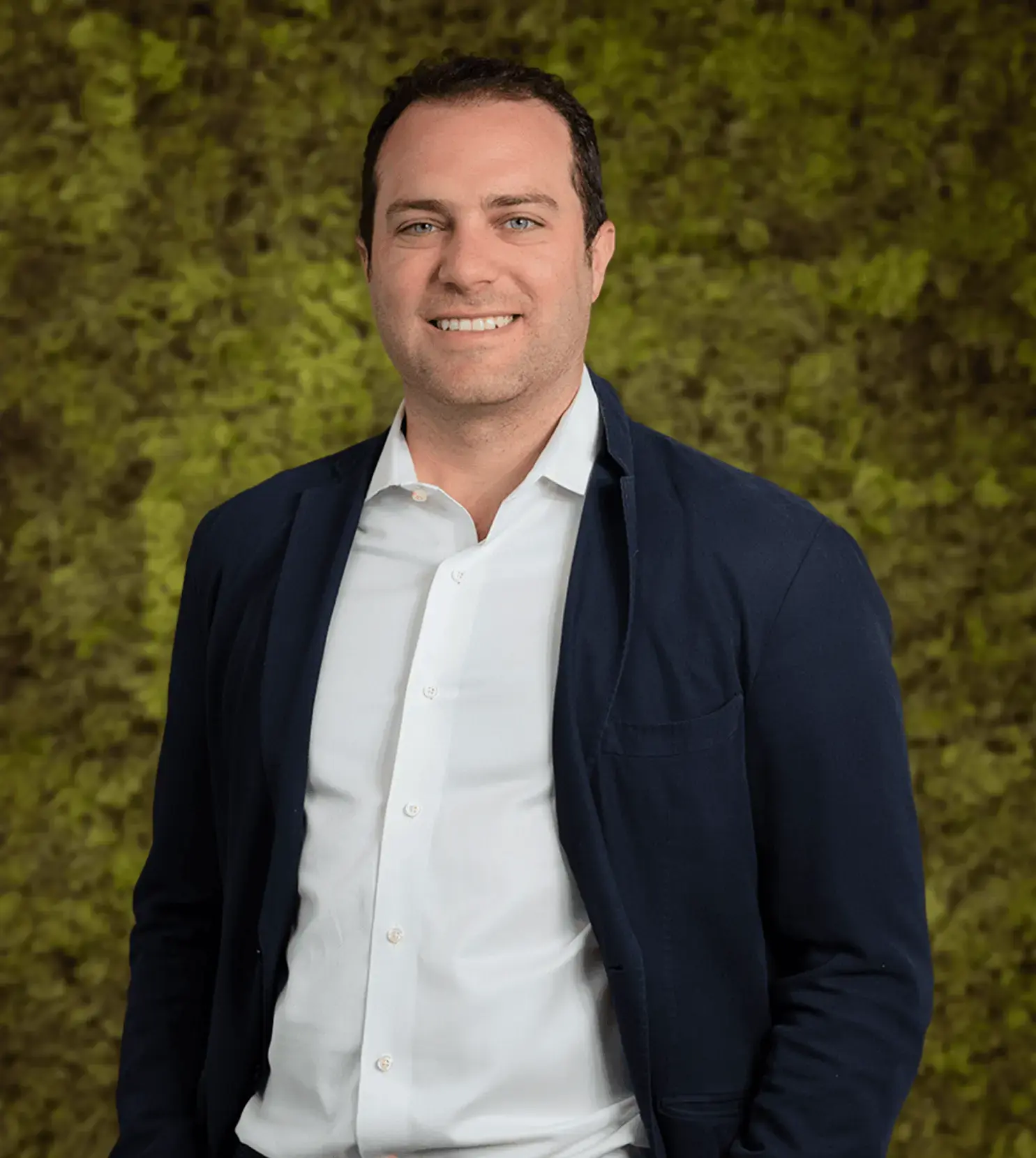
Alberto Pizzocchero
Alberto Pizzocchero
Circular economy Project Manager

Master’s degree in Environmental and Territorial Engineering, specialising in Environmental Remediation Technologies, from the Politecnico di Milano; qualified as a professional engineer, with a view to enhancing managerial and professional skills in current sustainability issues. Executive Master’s degree in Circular Economy Management from LUISS Business School. Specialises in sustainability, optimising waste management and treatment, and the principles and application of Green and Circular Economy in specific sector-based projects and within individual companies. Head of training on sustainability and the circular economy, with specific teaching roles on professional Master’s programmes at the Catholic University of Milan, 24Ore Business School and directly within companies through bespoke training programmes.

Luca Russo
Luca Russo
Head of ESG & Sustainability Strategy
Having obtained a Master’s degree in Environmental and Development Economics from the University of Siena, he developed his cross-disciplinary knowledge in the financial and energy sectors by completing a second-level Master’s in Energy Management at the Business School of the Politecnico di Milano. He specialises in risk analysis and the management of industrial portfolios at multi-utility companies, with a particular focus on renewable energy generation and specific environmental variables. She has developed a specialisation in ESG issues, drawing on her experience in certification and reporting, and has contributed to the design of sustainability strategies and the certification of areas such as diversity and inclusion, the supply chain and corporate social responsibility. She has supported the design and implementation of initiatives to engage internal and external stakeholders through engagement programmes and the measurement of financial and sustainability performance.
Leonardo Corbella
Leonardo Corbella
Sustainability & Carbon footprint Specialist
In 2019, he obtained a Master’s degree in Environmental and Territorial Sciences and Technologies from the University of Milan-Bicocca. Whilst working on his dissertation, he collaborated with the GREEN research group (Research Centre for Geography, Natural Resources, Energy, the Environment and Networks) at Bocconi University.
Having always been keenly interested in sustainability issues and eager to contribute actively to them, he began his professional career as a member of Circularity’s technical team, working as a Sustainability & Carbon Footprint Specialist. 
He specialises in the analysis of environmental data within the context of sustainability reporting projects and in conducting carbon footprint studies. Finally, he delivers training courses on sustainability and the circular economy, both as part of professional Master’s programmes at the 24Ore Business School and the Catholic University, and directly to companies through dedicated training programmes.


Start the training

Contact us